
A central vacuum system is meant to simplify life, not complicate it. When you discover your suction is gone, the first instinct is to fix it yourself—and often, you can! At LowCountryVacSew, we empower homeowners across the Lowcountry with the knowledge to handle minor issues. However, we also know precisely when a blockage transitions from a simple problem to a guaranteed job for professional service.
This guide will walk you through effective DIY checks and safe clog removal techniques. More importantly, it will detail the crucial moment when continuing a DIY attempt becomes a risk to your home’s infrastructure, making professional central vacuum clog repair Charleston SC the only logical next step.
Step 1: The Essential DIY Checklist (The Simple Fixes)
Before tackling the pipes inside your walls, you must eliminate the low-hanging fruit. A majority of reported “clogs” are actually simple fixes that mimic a pipe blockage.
1. Check the Canister and Filter
A full dirt canister or a heavily caked filter dramatically restricts airflow, resulting in low or no suction.
- Action: Empty the canister completely. If your system uses a bag, replace it. If it uses a permanent filter, clean it according to your power unit’s manual. A clean filter is vital for proper function.
2. Inspect the Hose and Powerhead
Most physical clogs happen in the hose, which is the most flexible and used part of the system.
- Action: Disconnect the hose from the wall and hold it up to the light to look for shadows or debris. For a quick check, gently drop a small coin through the hose. If it doesn’t immediately fall out the other end, the clog is in the hose. Use a broom handle (only on the hose, not the wall inlet) to push the blockage through.
3. Confirm the Power Unit is Running
If the power unit isn’t activating when you open an inlet, your problem is electrical, not a clog.
- Action: Check the circuit breaker for a tripped fuse. Also, look at the low-voltage wires connecting your inlet to the main line, ensuring no wire is pinched or disconnected.
Step 2: Isolating and Attempting a Minor Pipe Clog Fix
If the hose is clear and the power unit is working, the blockage is within the permanent pipe system. Here’s how to safely isolate and approach it:
A. Find the Clog Location
- Systematic Check: Test every inlet in your home. If the suction is bad at one inlet but fine at the others, the clog is localized to the short pipe run between that inlet and the main trunk line. This is the best-case scenario for a DIY fix.
- No Suction Anywhere: If every inlet has poor suction, the blockage is in the main trunk line, usually near the central unit or a sharp bend. This requires immediate professional intervention.
B. The Safe DIY Extraction Technique
For a localized clog near an inlet, you may be able to extract the item.
- The Right Tool: Use a non-marring tool, such as a stiff piece of plastic tubing or a very flexible, inexpensive plastic auger designed for sinks.
- The Goal: Gently push or prod the object enough for the main vacuum suction (or reverse shop vacuum suction) to pull it through.
⚠️ The Critical Line: When DIY Turns Into Disaster

This is the most important section of our guide. A deep-seated clog is lodged firmly in the elbows or fittings of your PVC lines. Trying to force it out is where homeowners make mistakes that require costly wall repair, costing far more than professional central vacuum clog repair Charleston SC.
| DIY Mistake | The Risk to Your Pipes | The Professional Solution |
| Using Metal Tools (Snakes/Hangers) | Metal edges can easily puncture the thin PVC pipe walls, creating an air leak that requires opening the drywall to access and repair the pipe junction. | We use specialized camera equipment to pinpoint the exact location and material of the clog before attempting a controlled removal. |
| Flushing with Water or Chemicals | Introduces moisture, which binds dust and fine debris into a heavy, cement-like block that is impossible to remove without replacing the entire section of pipe. | Our proprietary methods rely on powerful, concentrated dry air pressure and extraction, keeping the interior of your pipes clean and dry. |
| Ignoring a Main Line Clog | If the problem affects all inlets, forcing air/objects from one point is futile and risks lodging the material permanently at the power unit entrance. | We target the main line with high-powered reverse suction and “air pigging” to safely push the clog back toward the closest open inlet or extraction point. |
If you’ve checked the hose, emptied the canister, and attempted the gentle localized extraction without success, the clog is deep. This is the moment to stop—before you risk structural damage to your lines.
The LowCountryVacSew Guarantee: Expert Central Vacuum Clog Repair Charleston SC
Our service provides peace of mind and guarantees that your system will be running at full capacity, often within hours of our arrival. We possess the unique tools and specialized training required to fix deep central vacuum clogs safely and efficiently.
Our 3-Step, Risk-Free Service Process:
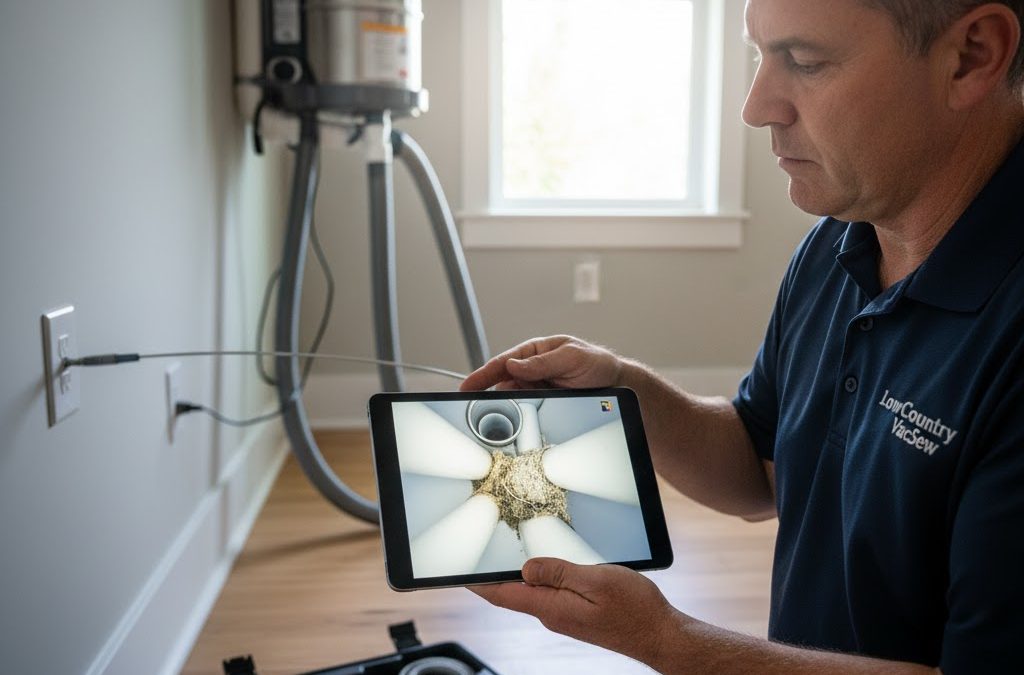
- Video Diagnostics: We start by feeding a tiny camera into the pipe system. We can identify what the clog is (sock, wood splinter, debris) and where it is located relative to the wall fittings.
- Specialized Extraction: Using the diagnostic information, we employ the perfect, non-damaging technique—whether it’s high-powered reverse suction or controlled air pressure—to clear the blockage safely.
- Performance Guarantee: We systematically test the suction at every single inlet in your home to ensure all pipes are flowing freely and your system’s power is fully restored. We service all major brands throughout the Lowcountry, including Beam, Electrolux, Cyclovac, and more.
Don’t let a deep clog turn into a disaster that requires drywall repair. If your DIY attempts haven’t worked, the risk of damage is too high.
Call LowCountryVacSew today at (843) 766-3347 to schedule guaranteed central vacuum clog repair Charleston SC, or visit our service page to book your appointment online.